

TRUST & TRANSPARENCY
How Phronesis Provides Trusted UK HR Guidance
Phronesis combines AI-powered HR guidance with authoritative UK employment sources, built-in safety guardrails and access to qualified human HR expertise when a situation requires professional judgement.
Every answer is designed to be clear, practical and transparent showing you the basis for the guidance, how confident Phronesis is in the answer, and when you should involve a human HR professional

SCOPE
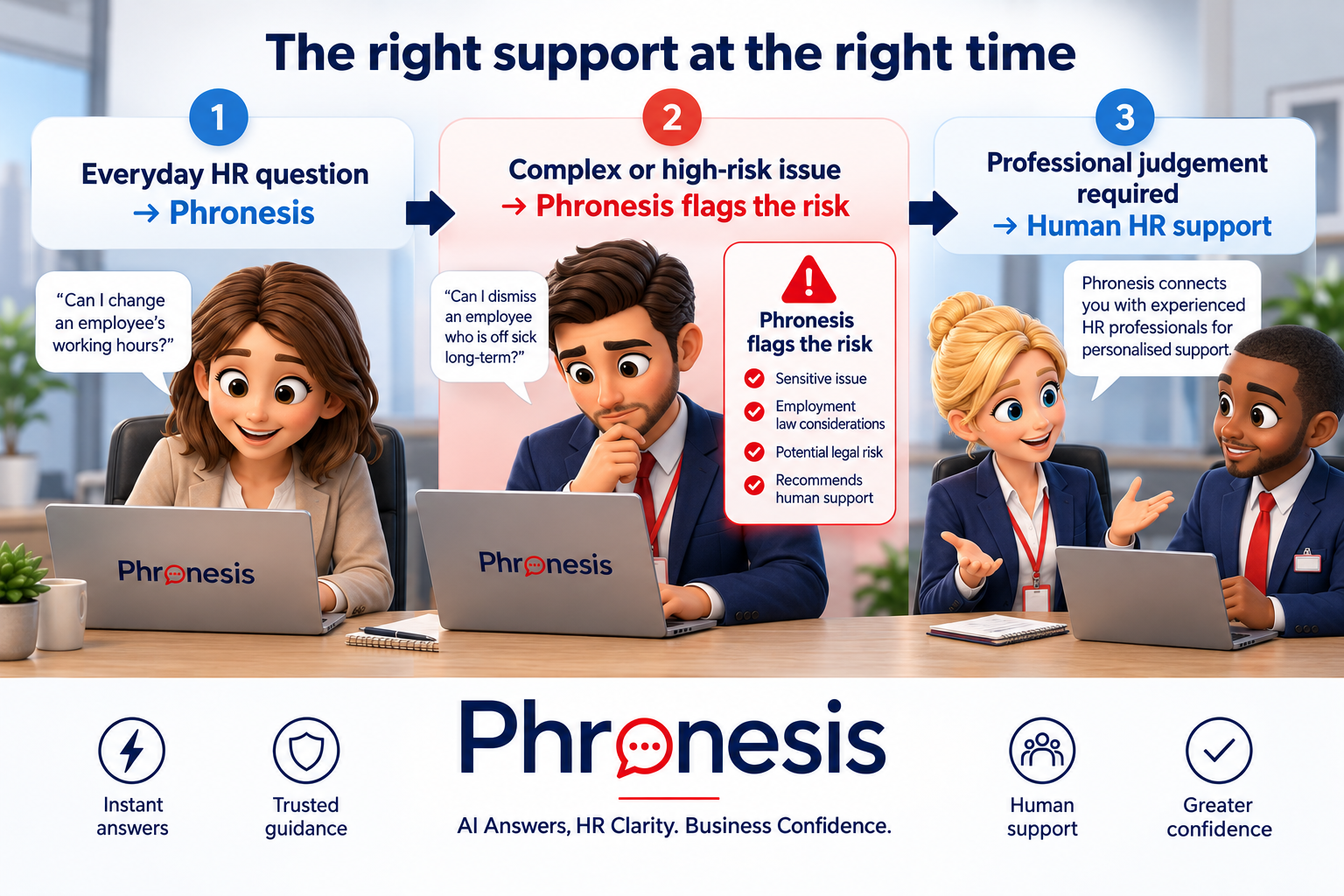
When Phronesis flags that human HR expertise is needed
Phronesis is designed to recognise when an HR situation may be too complex, sensitive or high-risk to rely on AI guidance alone.
In these circumstances, Phronesis will flag the risk and recommend escalation to a qualified HR professional or, where appropriate, an employment solicitor.
Phronesis therefore doesn't attempt to replace professional judgement. It helps you recognise when professional judgement is needed.
Typical situations where escalation makes sense
• Potential dismissal or gross misconduct
• Discrimination, harassment or reasonable adjustments
• Whistleblowing or protected disclosures
• Redundancy and collective consultation
• TUPE
• Settlement agreements
• Complex grievances and disciplinary matters
• Workplace investigations or disputed facts
• Long-term sickness or sensitive absence cases
• Employment Tribunal proceedings
• Complex contractual disputes
What happens when human support is recommended?
If Phronesis identifies an issue where professional judgement would be advisable, it will tell you clearly.
Users can then seek support from their own HR adviser or employment solicitor, or access qualified human HR support through our sister company, SME HR Consultancy.
This creates a simple model
METHOD
How a Phronesis HR answer is built
Phronesis doesn't simply generate an AI response. It applies a structured HR methodology designed around accuracy, transparency and safe decision-making.
A note on accuracy: if key facts are missing, Phronesis will ask clarifying questions rather than guessing. If the scenario looks high-risk, it will recommend escalation.
1) Plain-English summary
A short answer first, so you know where you stand.
2) Key risks
What could go wrong, and what to watch for.
3) Step-by-step actions
A practical checklist you can follow.
4) Authoritative UK Sources
Phronesis prioritises authoritative UK sources when generating HR and employment guidance.
Sources are considered in the following hierarchy:
UK legislation
Binding case law
UK Government guidance
ACAS Codes of Practice and guidance
Established professional HR practice
General commentary
Where relevant, Phronesis provides links to the sources referenced so users can verify the basis of the guidance themselves.
5) Confidence level
Every Phronesis response includes a High, Medium or Low confidence rating, helping you understand how certain the guidance is.
High — supported by clear legislation, ACAS guidance or other authoritative sources with few significant assumptions.
Medium — established HR principles apply, but some facts are missing or professional interpretation is required.
Low — the issue is highly fact-specific, information is incomplete or there is significant uncertainty.
A low confidence rating is an important signal that additional information or human professional judgement may be required
Built-in AI HR guardrails
HR decisions affect real people. That's why Phronesis has been designed with specific HR safety and quality guardrails rather than relying on unrestricted AI responses.
These guardrails are designed to make AI-generated HR guidance more transparent, responsible and useful for UK employers.
Phronesis is designed to:
Never invent legal authorities, cases or statistics
Distinguish verified facts from assumptions and interpretation
Ask for important missing information rather than guess
Prioritise authoritative UK employment sources
Provide a confidence rating with every answer
Recognise when employment status or length of service may affect the answer
Consider fairness and different perspectives
Flag sensitive or high-risk HR situations
Recommend human professional support when appropriate
FAQ
Quick answers
-
No. Phronesis provides general guidance to help you understand options and next steps. It does not replace tailored advice from a solicitor or HR professional, and it cannot assess every fact in your situation.
-
Phronesis can provide SMEs with consistent, on-demand answers to many everyday HR and employment questions without requiring a full-time HR professional. It does not replace human judgement in complex or high-risk cases. Instead, it identifies when professional HR or legal support should be considered
-
Phronesis is designed around current UK employment legislation, ACAS codes of practice and guidance, and relevant Employment Tribunal and EAT case law.
The Phronesis methodology is also informed by more than 25 years of senior HR experience across UK organisations, bringing practical professional HR judgement alongside authoritative employment-law sources.
Where appropriate, it points you to authoritative references so you can verify the basis for the guidance.
-
Yes. Phronesis is designed to flag potentially high-risk or fact-sensitive situations such as dismissal, discrimination, whistleblowing, complex grievances and redundancy, and recommend human professional support where appropriate.
-
If the situation is high-risk or sensitive (for example: potential dismissal, redundancy, discrimination, whistleblowing, long-term sickness, or a grievance), you should seek professional support. Phronesis includes a human escalation path via our sister company, SME HR Consultancy. It will also clearly indicate when escalation is advisable.
-
Yes. Phronesis is built to support an audit trail so you can keep a record of questions asked and guidance received. This helps with consistency and internal documentation.
-
Data is encrypted in transit and at rest. Your queries are not shared with third parties or used to train other models. Phronesis is built to support GDPR compliance.